
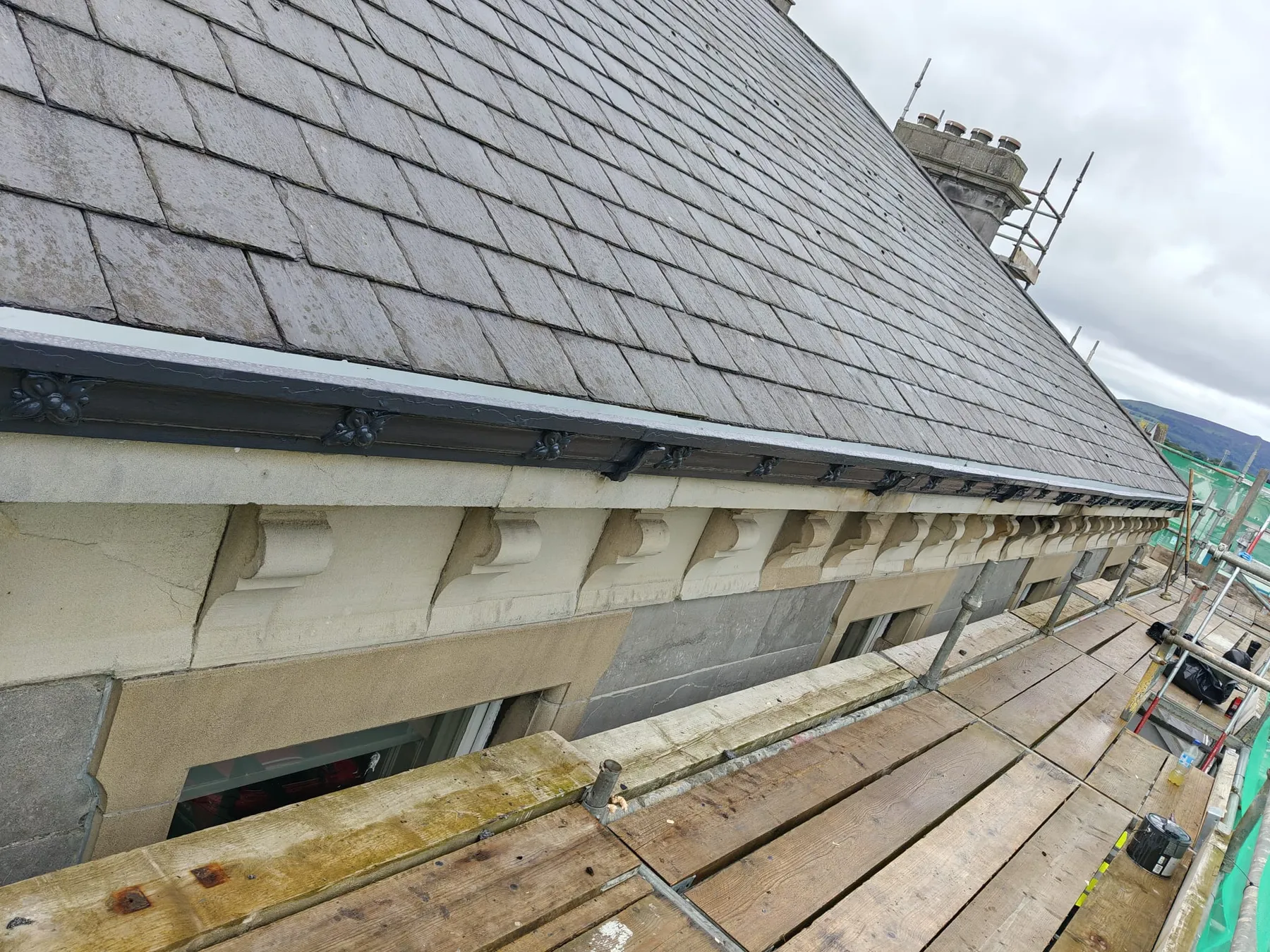

Recommended Guttering in Dublin
Prices, guarantees and what Dublin homeowners actually get for the money
Recommended Guttering is the Dublin arm of Recommended Guttering, founded in 2019 by Patrick Foley, with directly employed crews, a 10-year written workmanship guarantee, and a Lifetime Leak Guarantee on every full replacement. Repairs across Dublin start at €500, most land €1,000–€1,900, and a full semi replacement runs €1,000–€6,500 depending on material. Rated 5.0★ on Google.
Recommended Guttering in Dublin at a Glance
- Trading since 2019 as the Dublin guttering site of Recommended Guttering, operating from 24A Baggot Street Upper, Dublin 4, with the phone answered Mon–Sat 08:00–18:00 on 01 582 0079.
- Insurance cover is €6.5M public liability and €13M employer liability, VAT registered IE04393055LH, and registered with the Construction Industry Register Ireland.
- Gutter repair in Dublin starts at €500, with most jobs landing €1,000–€1,900, and extensive or cast iron work €1,900–€3,000; all figures indicative and confirmed free after a survey.
- A full gutter replacement on a typical Dublin three-bed semi runs €1,000–€1,400 in uPVC, €1,300–€1,800 in aluminium, or €2,100–€2,800 in cast iron, including removal, brackets, downpipes and outlets.
- Every job carries a 10-year written workmanship guarantee, and every full replacement additionally carries the Lifetime Leak Guarantee, handed over in writing before contracts are signed.
- Google rating is 5.0★ across 20+ reviews, with public-sector and commercial work for Bank of Ireland, the HSE and Clare County Council.
Read next: Seamless Aluminium Gutters in Dublin, Gutter Installation in Dublin, Gutter Cleaning in Dublin.
Are Recommended Guttering any good?
Fair question, and the honest answer sits in four checkable things rather than adjectives. Recommended Guttering holds a 5.0★ rating across 20+ Google reviews, employs its roofline crews directly rather than subcontracting, carries €6.5M public liability and €13M employer liability insurance, and is registered with the Construction Industry Register Ireland. The guarantee is handed over in writing before contracts are signed, not promised afterwards.
The Dublin market is crowded with names, and most will quote a gutter job from the ground. We go up and look, because the difference between a failed joint and an undersized profile is not visible from a driveway, and that distinction can be the difference between a €600 repair and a €3,500 replacement. The crew that quotes the work is the crew that does the work.
What does guttering cost in Dublin?
Material is the single biggest lever on price, followed by run length, height and access, and whether the fascia behind the gutter is sound. Per metre installed, uPVC runs €50–€65, aluminium €65–€75, and cast iron €75–€90. Multiply by run length to sanity-check any whole-job figure: a standard Dublin three-bed semi carries roughly 15–20 metres front and rear combined.
Full replacement — by material and house size
| Material | Typical semi (~20 m) | Larger or detached (~50 m) |
|---|---|---|
| uPVC | €1,000 – €1,400 | €2,900 – €3,600 |
| Aluminium | €1,300 – €1,800 | €3,600 – €4,500 |
| Cast iron (period / conservation) | €2,100 – €2,800 | €5,500 – €6,500 |
Includes removing and disposing of the old system, new brackets, downpipes and outlets. A large or complex Dublin property runs higher; the largest replacement to date was €12,689. All prices indicative and confirmed free after a survey.
Repair — three honest bands
| The job | Typical cost |
|---|---|
| Small — a couple of leaking joints on one run | €500 – €800 |
| Typical — sagging run re-aligned, brackets renewed, joints re-sealed, a downpipe | €1,000 – €1,900 |
| Extensive or cast iron — multiple runs, period property, welding and restoration | €1,900 – €3,000 |
Repair price is driven far more by how much of the system is being worked on than by the metreage of the house. A short run on a Rathmines redbrick with cast iron beats a long run of uPVC on a modern semi.
Gutter cleaning is priced per job after a look at the house rather than per metre, because size, height, access and how much is up there each move the number. There is no call-out fee, and downpipes are included; a clear gutter clean in Dublin that leaves a blocked downpipe achieves nothing.
What type of guttering is best for Dublin homes?
The best choice depends on the house's age, its exposure and how long you plan to keep it. For a 1930s semi in Cabra or a 1970s estate in Tallaght, well-fitted uPVC gives thirty years or more and is the lowest cost per metre. For coastal exposure in Howth, Sutton, Malahide or Clontarf, where wind loading pulls brackets off inland profiles, seamless aluminium gutters are the right answer — one continuous run with no mid-span joints to fail. For Georgian and Victorian redbricks in Rathmines, Phibsborough, Drumcondra, Portobello or Ranelagh, cast iron is usually worth repairing in matching sections rather than replacing with modern profile.
The deeper rule: on many 1970s Dublin estates the standard 112mm half-round is undersized for the roof area, so the gutter overflows even when perfectly clean. Upsizing to a 125mm deep-flow profile is the fix, and no amount of cleaning or resealing will do it.
What are the three types of gutters, and which lasts longest?
The three materials you actually choose between on a Dublin house are uPVC, aluminium and cast iron. uPVC is the cheapest and the most common on post-1970s stock; aluminium is the middle ground and the right call for coastal and larger properties, especially as a seamless run; cast iron is the heritage choice for period homes and the longest-lasting of the three.
For longevity: well-fitted uPVC should give thirty years or more before UV brittleness and hardened joint seals bring it to the end of its life. Aluminium runs considerably longer, with no joints to perish on a seamless installation. Cast iron on a period Dublin house, properly maintained and repainted on cycle, outlasts everyone reading this.
What's the rule of thumb for gutter size?
For most Dublin semis a 112mm half-round profile is standard and sufficient. On larger roofs, long single runs, or any house that has overflowed when the gutter was known to be clear, step up to a 125mm deep-flow. The clue is the overflow pattern: a blockage dams the water at one point, a failed bracket drips behind the fascia, but a full-length overflow along a clean run means the profile cannot carry the roof's volume in Irish rainfall and nothing short of upsizing will fix it.
Bracket spacing matters more on exposed coastal gables in Howth, Sutton and Sandymount than it does inland. A run that is fine in Tallaght will pull away in a December southerly on an exposed Howth gable.
What is the most common problem with Dublin gutters?
Overflow at the front after cleaning, and it has three causes that need telling apart before money is spent. A blockage or lost fall dams the run at one point. A failed joint or bracket drips behind the gutter onto the fascia. And on many older Dublin houses the profile is simply too small for the roof area, in which case no repair fixes it and the gutter must be upsized. We go up and look, because none of this is diagnosable from a driveway.
The second most common call is a sagging run on a 1930s or 1940s semi where the fascia board behind the brackets has gone soft, so there is nothing left for a new bracket to bite into. In that case the gutter, fascia and soffit all come off and go back on in one visit — more work, but considerably cheaper than doing it twice.
Guarantees
Two guarantees, never blurred:
- 10-year written workmanship guarantee on every job we install or repair, handed over in writing before contracts are signed.
- Lifetime Leak Guarantee on every full replacement — a complete new gutter or roofline. Repairs and partial work do not carry it.
Insurance certificates, the CIRI registration number and the VAT number are available on request before we are appointed, and we actively encourage people to check them.
How the job actually runs
A call or form submission reaches the office directly. We arrange a free survey — no call-out fee — and go up and inspect rather than pricing from the ground. You receive a written quote with a breakdown of what is being done and what it costs, with the guarantee terms in writing before anything is signed. Most repairs and cleans are a single visit; a full gutter installation on a Dublin semi is typically one to two days. The run is tested with water before we leave, and the guarantee is handed over on completion.
For an overflowing gutter in heavy rain that is tracking into a wall or a ceiling, say so on the phone and we prioritise it on the day the diary allows.
Get a free quote in Dublin
Call 01 582 0079 Mon–Sat 08:00–18:00, or request a free survey from Recommended Guttering in Dublin. You receive a written breakdown before anything is signed, with 10 years in writing on the work, and the Lifetime Leak Guarantee as well where the roofline is being fully replaced.
Questions, answered.
What type of guttering is best?
For most Dublin homes, well-fitted uPVC at €50–€65 per metre installed is the best value and gives thirty years or more. For coastal exposure or larger properties, seamless aluminium is the better call because it has no mid-span joints to fail. For period redbricks, cast iron is the right answer and is usually worth repairing in matching sections rather than replacing.
What is the rule of thumb for gutters?
A 112mm half-round profile handles most Dublin semis. Step up to a 125mm deep-flow where the roof is larger, the runs are long, or the gutter has overflowed when known to be clean. Bracket spacing tightens on exposed coastal gables, because wind loading in Howth and Sutton pulls brackets that would hold inland.
Which brand of gutter is best?
Brand matters less than material, profile and fitting. We fit uPVC, aluminium and cast iron from the main Irish suppliers in the common colours — black, brown, grey and white — and the determining factors on longevity are correct bracket spacing, the right profile for the roof, and that the fascia behind the gutter is sound.
What to look for when buying gutters?
Insurance cover, a written workmanship guarantee, directly employed crews rather than subcontracted labour, and a written quote with a breakdown before signing. Ask to see the CIRI registration and the insurance certificates; a genuine contractor hands them over without hesitation. Our figures are €6.5M public liability, €13M employer liability, and 10 years in writing.
What are the three types of gutters?
In Irish housing the three practical choices are uPVC, aluminium and cast iron. uPVC dominates post-1970s stock, aluminium is the middle option and the right call for seamless installation on coastal and larger homes, and cast iron is the heritage material on Georgian and Victorian properties.
What type of gutters last the longest?
Cast iron, properly maintained, outlasts the other two by a wide margin on a period Dublin home. Aluminium is next, especially as a seamless run with no joints to perish. Well-fitted uPVC should still give thirty years or more.
What is the most common problem with gutters?
Overflow after cleaning, caused by a lost fall, a failed joint behind the gutter, or an undersized profile that cannot carry the roof's volume in Irish rainfall. All three look identical from the ground, which is why we go up and inspect rather than quoting on sight.
What is the most popular gutter size?
112mm half-round in uPVC is the standard across most Dublin housing. Where overflow is chronic on a clean run, 125mm deep-flow is the upsize, and that single change often removes the problem without any other work.
What's better than gutters?
Nothing you can retrofit to an existing Irish house. Gutter guards get asked about a lot; on most Dublin homes a scheduled clear is cheaper and works better, because guards keep leaves out but trap silt and moss and still have to be cleaned. Guards earn their place under heavy overhanging trees where access is genuinely difficult.
Do you charge VAT and a call-out fee?
VAT applies to the final invoice at the prevailing rate. There is no call-out fee. Surveys and quotes are free, with a written breakdown before anything starts, and no deposit is taken on small repair work.
Is storm damage to a gutter covered by home insurance?
Storm damage to guttering is usually covered under the storm peril of a standard home policy, subject to the excess. Wear and tear, blockage and age-related failure are not. If a gutter has come away in a named storm, photograph it immediately and get a written report before any repair starts.
Are there grants for guttering work?
There is no direct SEAI grant for guttering itself. If guttering is being replaced as part of a wider energy upgrade with external insulation or a deep retrofit, the roofline work is bundled into the main contract rather than grant-aided on its own. See SEAI grants for the current schemes.
Get your gutters
sorted today.
Tell us what is wrong with your gutters — we will come back fast with a clear, written quote. Or call us: