
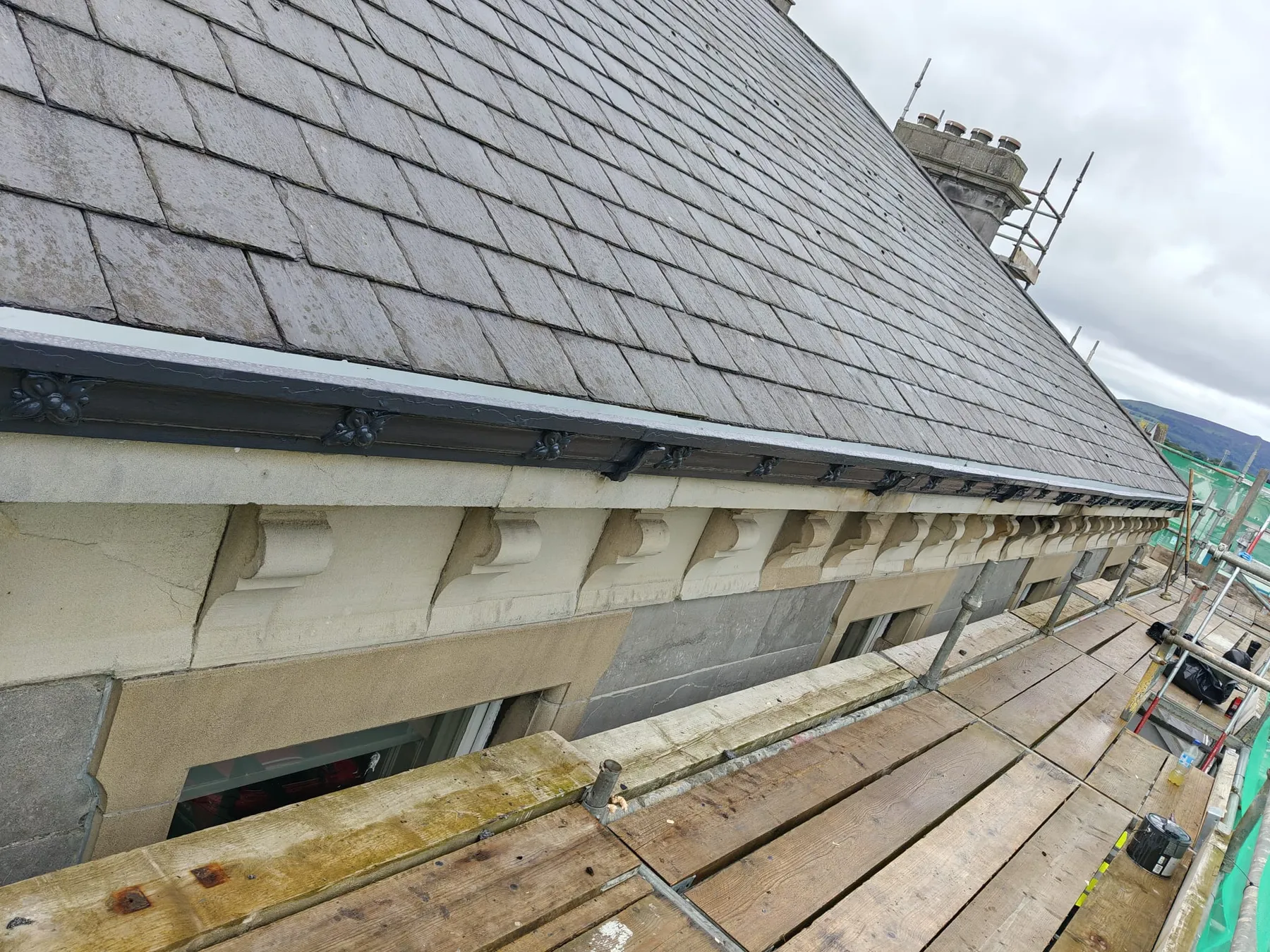

Guttering Installation in South Dublin
What a new system costs, how long it takes, and what moves the price on a Rathgar semi or a Dundrum detached
Guttering installation in South Dublin typically runs €1,000–€1,800 for a standard three-bed semi in uPVC and €1,300–€1,800 in seamless aluminium, with cast iron on period homes from €2,100. A straightforward semi is a one to two day job, carried out by directly employed Recommended Guttering crews and backed by a 10-year written guarantee and our Lifetime Leak Guarantee.
Read next: Gutter Installation in Dublin · Seamless Aluminium Gutters in Dublin · Gutter Cleaning in Dublin
Guttering Installation Costs in South Dublin at a Glance
- A full uPVC gutter replacement on a typical South Dublin three-bed semi (around 20 metres of run) is indicatively €1,000–€1,400, confirmed free after a survey.
- Seamless aluminium on the same semi is indicatively €1,300–€1,800, with cast iron for period homes in Rathgar or Terenure from €2,100–€2,800.
- A larger detached house in Dundrum or Foxrock, carrying 40–50 metres of run, is indicatively €2,900–€3,600 in uPVC and €3,600–€4,500 in aluminium.
- Most South Dublin installations take one to two days on a semi, two to three days on a larger detached, including removal of the old system and new downpipes.
- Material is the single biggest lever on price: materials alone run about €10 per metre for uPVC up to €50 per metre for cast iron.
- Every full installation carries a 10-year written workmanship guarantee and the Lifetime Leak Guarantee, handed over in writing before contracts are signed.
How much does guttering installation cost in South Dublin?
The honest answer in South Dublin is a grid, not a single number, because material and length of run move the figure more than anything else. On a standard semi carrying roughly 15–20 metres of run across front and rear, a full uPVC replacement is indicatively €1,000–€1,400. Seamless aluminium on the same house is €1,300–€1,800. Cast iron, which is often the right call on a Rathmines or Ranelagh redbrick, is €2,100–€2,800.
A larger property shifts the arithmetic. A detached home in Mount Merrion, Churchtown or Foxrock with around 50 metres of guttering is indicatively €2,900–€3,600 in uPVC, €3,600–€4,500 in aluminium, and €5,500–€6,500 in cast iron. These figures include stripping and disposing of the existing system, new brackets and unions, fresh outlets and new downpipes to the gullies. The largest full replacement Recommended Guttering has carried out to date came in at €12,689, on a complex period property with multiple elevations.
What moves the price on any South Dublin job, every time: the length of run, the material, the height and access, whether the fascia behind the gutter is sound, and whether the downpipes are being renewed at the same time. All quotes are free, with a written breakdown before anything starts, and there is no call-out fee.
What are the three main types of guttering we fit in Dublin?
uPVC, aluminium and cast iron are the three systems that account for virtually every South Dublin installation. uPVC is the standard choice on 1930s to 1970s estate housing across Terenure, Templeogue, Walkinstown and Tallaght, because it is cost-effective, available in the common colours (black, brown, grey and white), and should give thirty years or more when fitted properly.
Seamless aluminium is the sensible step up on larger homes and anywhere the owner wants fewer joints to fail. The run is formed on site to the length of the elevation, which removes the joint every few metres where uPVC tends to leak first. On exposed properties in Dun Laoghaire, Blackrock or Monkstown it also tolerates wind loading better. Our seamless aluminium gutter installation across Dublin covers the detail of profile sizes, colours and brackets.
Cast iron is the heritage option, and the right one on Georgian and Victorian redbrick in Rathmines, Rathgar, Ranelagh and Portobello. Original cast iron is often worth saving in matching sections rather than replacing the lot; where it has rusted through the base of the section, new cast iron in a matching ogee profile is the correct replacement rather than switching to uPVC on a protected or sensitive elevation.
How much to replace guttering on a 4 bed detached house?
A four-bed detached house in South Dublin usually carries 40–55 metres of guttering across front, rear and the extension or garage return. On that scale, a full uPVC replacement is indicatively €2,900–€3,600, seamless aluminium is €3,600–€4,500, and cast iron where the house warrants it is €5,500–€6,500. Those figures include removing the old system, new brackets at the proper spacing, unions, outlets and new downpipes to the gullies.
Three things push a four-bed figure to the upper end of the range or beyond. A two-storey elevation with awkward access over a conservatory or extension adds time. Rotted fascia behind the gutter has to be replaced in the same visit, because there is nothing left for a new bracket to bite into. And a run that overflows along its full length even when clean is usually undersized for the roof it serves, in which case we fit a 125mm deep-flow profile rather than replace like-for-like.
How long does a new gutter installation take in South Dublin?
Most South Dublin installations are a one or two day job on a semi, and two to three days on a larger detached. We arrange a free survey first, go up and look rather than pricing from the ground, and issue a written quote with the guarantee terms before anything is signed. The directly employed crew then arrives on the agreed day with the material already cut to length.
The sequence on site is straight: strip and remove the old system, check and renew any failed fascia behind it, set the fall from the high point to the outlet, fix new brackets at the correct centres for the material, run the new gutter, fit downpipes to the gullies, and flush the whole system with water before we leave so the customer sees it clears. On seamless aluminium the gutter is formed on site, so there is no waiting on sections to arrive from a merchant.
What is the most common problem with gutters on Dublin houses?
Overflow at the front after rain is the single most common call across South Dublin, and it has three distinct causes that need telling apart before any money is spent. The first is a blockage or a lost fall damming the run at one point; a clean and a re-set of the fall solves it. The second is a failed joint or bracket dripping behind the gutter onto the fascia, which looks like overflow from the ground but is actually a leak behind the system.
The third, and the one that keeps bringing people back to the same contractor, is a profile that is simply too small for the roof area. This is widespread on 1970s South Dublin estates in Tallaght, Firhouse and Knocklyon, where the standard 112mm half-round was fitted to roofs it was never sized for. No repair fixes an undersized profile. The correct installation is a 125mm deep-flow upgrade on the elevations that overflow, which is a different job from a like-for-like replacement and worth a line on the quote.
What is the lifespan of a new gutter in Dublin?
Well-fitted uPVC should give thirty years or more in Dublin's climate, which is the honest figure to work from on a South Dublin semi. Aluminium runs considerably longer, often fifty years or more, because the material does not go brittle in UV the way uPVC eventually does. Cast iron, maintained and painted, lasts a century; the cast iron coming off Rathmines and Portobello today was fitted before 1920.
Lifespan on all three depends more on fitting than on material. Brackets too far apart will cause any profile to sag between fixings on an exposed coastal gable in Sandymount or Dun Laoghaire. Downpipes that discharge against a wall rather than into a gully will fail the fascia from behind long before the gutter itself gives out. These are fitting decisions, not material decisions, and they are what the 10-year written guarantee stands over.
How often does guttering need replacing in South Dublin?
Most South Dublin uPVC fitted in the 1980s and 1990s is now at the end of its usable life, which is why replacement calls on Templeogue, Rathfarnham and Dundrum semis have become steady work. The honest trigger for replacement is not age but behaviour: a run that sags between every bracket, cracks along its length, or has more patches than gutter has stopped being economical to repair.
Before that point, repair is cheaper and we quote it that way. A single failed joint, one pulled-through bracket or a short damaged section is a repair, not a reason to renew a whole elevation. Where the fascia is sound, repairs on Dublin uPVC can hold for years. We repair before we replace, and we say so plainly in writing.
Our experience across South Dublin
Recommended Guttering is the Dublin guttering site of Recommended Guttering, founded in 2019 by Patrick Foley on one principle: employ the crews directly, guarantee the work in writing, and stand over every job personally. We cover 78 areas across Dublin city and county, with South Dublin runs from Rathmines and Ranelagh out through Churchtown, Dundrum, Rathfarnham and Terenure to Tallaght, Firhouse and the newer Citywest developments.
The age-band of the house usually predicts the job. Georgian and Victorian redbrick in Rathmines and Portobello calls for cast iron repair or replacement in matching sections. 1930s and 1940s semis in Crumlin and Terenure usually need a full uPVC renewal because the original material has gone brittle from UV and the joint seals have hardened past the point of resealing. 1970s estates in Tallaght and Clondalkin frequently need upsizing to a 125mm deep-flow profile because the original 112mm half-round was undersized for the roof. Newer Citywest and Adamstown houses are generally sound, and the calls there are blockages and the occasional bracket.
We hold €6.5M public liability and €13M employer liability insurance, are registered with CIRI (the Construction Industry Register Ireland), and are members of the National Guild of Master Craftsmen. The Google rating is 5.0 stars across more than 20 reviews. All of that paperwork is available before we are appointed.
If you want a written quote for a new gutter installation on a South Dublin home, request a free survey from Recommended Guttering in Dublin or call the office on 01 582 0079. The survey is free, there is no call-out fee, and the written breakdown lands before any decision is asked for.
Guarantees
Every full gutter installation in South Dublin carries two guarantees. The 10-year written workmanship guarantee covers everything we install. The Lifetime Leak Guarantee covers leaks on any full roofline replacement, for as long as you own the home. Both are handed over in writing before contracts are signed, not promised afterwards. Repairs on their own carry the written workmanship guarantee only.
Book a free survey
To arrange a free survey and a written quote for guttering installation in South Dublin, call Recommended Guttering on 01 582 0079 or request a free quote for gutter installation in Dublin. There is no call-out fee, the survey is free, and because this is a full installation it carries both the 10-year written workmanship guarantee and the Lifetime Leak Guarantee.
Questions, answered.
How much does it cost to replace gutters in Dublin?
Indicative figures across Dublin are €1,000–€1,400 for uPVC on a standard semi, €1,300–€1,800 for seamless aluminium, and €2,100–€2,800 for cast iron on a period home. Larger detached properties run €2,900–€4,500 in uPVC or aluminium. Every figure is indicative and confirmed free after a site survey.
What are the three types of gutters?
The three systems that account for almost every Dublin installation are uPVC, aluminium (increasingly fitted as seamless) and cast iron. uPVC suits most 1930s to 1970s estate houses, aluminium suits larger homes and exposed sites, and cast iron is the correct choice on Georgian and Victorian redbrick.
How much to replace guttering on a 4 bed detached house?
A South Dublin four-bed detached carrying 40–55 metres of run is indicatively €2,900–€3,600 in uPVC, €3,600–€4,500 in aluminium, and €5,500–€6,500 in cast iron. Access, fascia condition and whether downpipes are being renewed move the figure within the range. Exact rates confirmed free after a survey.
What is the most common problem with gutters?
Overflow at the front after rain, with three distinct causes: a blockage or lost fall, a failed joint or bracket leaking behind the gutter, or a profile that is simply undersized for the roof area. Only the third requires a full replacement; the first two are repairs.
What can I do instead of gutters?
Very few Dublin houses can go without. The practical alternatives, used on specific designs, are rain chains, French drains at the dripline, or wide roof overhangs designed to throw water clear of the wall. On a standard Dublin semi exposed to 750–1,000mm of annual rainfall, none of these replaces a proper gutter and downpipe system.
What is the lifespan of a gutter?
Well-fitted uPVC gives thirty years or more, aluminium considerably longer, and cast iron a century when maintained. Lifespan is driven more by fitting (bracket spacing, fall, downpipe discharge) than by material, which is what the 10-year written workmanship guarantee stands over.
What is the little known trick for gutters?
Flush the whole system with water before signing off any job. A visual check from the ground does not show whether the downpipe actually clears to the gully; a full flush does. On every Recommended Guttering installation the system is tested with water before we leave.
What are the worst gutter guards according to consumer reports?
The weakest performers across independent testing tend to be loose foam inserts and thin brush-style guards, which clog with silt and moss and then shed debris into the gutter. Rigid mesh and solid-cover guards perform better. On most Dublin houses, however, a scheduled clean is cheaper and more effective than any guard.
How often does guttering need replacing?
Not on a schedule, but when behaviour says so: a run that sags between every bracket, cracks along its length, or has had more repairs than it has clean gutter. Most Dublin uPVC fitted in the 1980s and 1990s is now at that point.
Is VAT included in the quoted price?
Yes. Every written quote from Recommended Guttering shows the full price including VAT, so the figure quoted is the figure paid. Our VAT number (IE04393055LH) is on the quote.
Do I need scaffolding for a gutter installation?
Not usually on a two-storey Dublin semi, where a tower or ladder access is standard. Scaffolding is specified only where the roof pitch, height or access genuinely requires it, and if so it is itemised separately on the written quote rather than hidden in the headline figure.
Will the installation be guaranteed?
Yes. Every full gutter installation from Recommended Guttering carries a 10-year written workmanship guarantee and the Lifetime Leak Guarantee, handed over in writing before contracts are signed. Repairs on their own carry the written workmanship guarantee but not the Lifetime Leak Guarantee, which is reserved for full replacements.
Get your gutters
sorted today.
Tell us what is wrong with your gutters — we will come back fast with a clear, written quote. Or call us: