
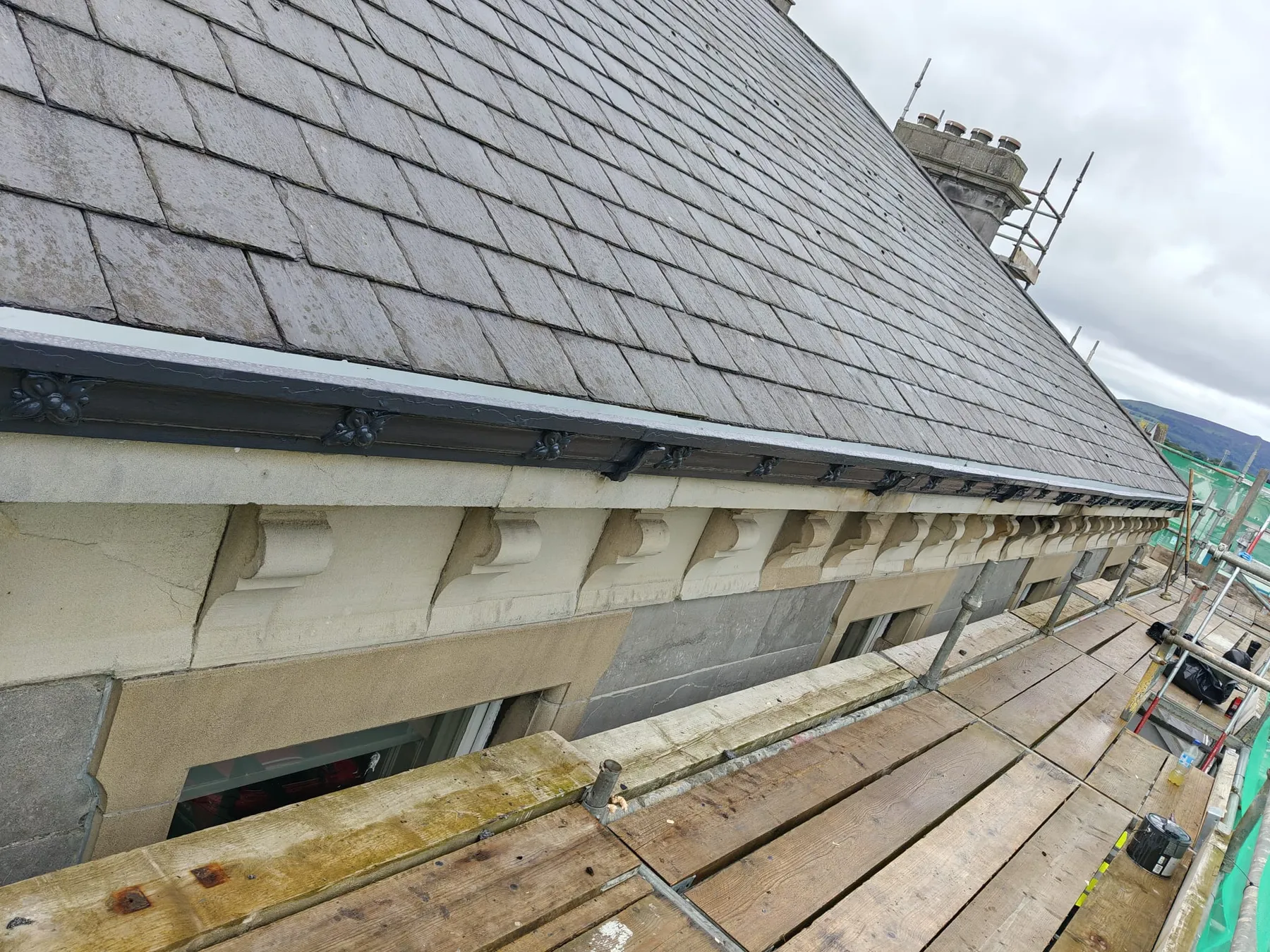

Gutter, Fascia and Soffit Replacement in Dublin
What it costs in 2026, uPVC versus aluminium, and why Clontarf, Sutton and Howth Head fascias fail quicker than inland homes
Full gutter, fascia and soffit replacement on a typical Dublin semi runs €2,400 to €3,800 in uPVC and €3,100 to €4,900 in aluminium (2026 indicative, confirmed free after survey). The three are usually done in one visit because the gutter has to come off to reach the fascia board, and doing them separately costs considerably more. On sea-facing homes in Clontarf, Sutton and Howth Head the roofline fails five to ten years earlier than inland Dublin, driven by salt-laden wind and horizontal rain.
Read next: Seamless Aluminium Gutters in Dublin · Gutter Installation in Dublin · Gutter Cleaning in Dublin
Dublin Roofline Replacement Costs at a Glance
- A typical three-bed Dublin semi carries roughly 15 to 20 metres of guttering front and rear combined, which is the figure that drives every quote.
- uPVC fascia and soffit with new uPVC gutter on a Dublin semi is €2,400 to €3,800 indicative in 2026; aluminium gutter on the same house is €3,100 to €4,900.
- Larger detached homes with 40 to 50 metres of run come in at €4,500 to €6,800 for uPVC and €5,500 to €8,200 for aluminium (indicative, confirmed after survey).
- Coastal Dublin properties in Clontarf, Sutton, Howth Head, Sandymount and Dun Laoghaire typically need roofline replacement every 20 to 25 years rather than the 30-plus years inland uPVC achieves.
- Every full gutter or roofline replacement by Recommended Guttering carries a 10-year written workmanship guarantee plus a Lifetime Leak Guarantee; repairs do not carry the Lifetime guarantee.
- Site surveys and written quotes are free, with no call-out fee, and the price quoted is the price paid.
Why Dublin Fascias and Soffits Rot in the First Place
The fascia board is the timber (or on newer houses, uPVC-clad timber) that the gutter screws into along the eaves. The soffit is the horizontal board tucked underneath, closing the gap between the wall and the gutter line. When either goes soft, there is nothing solid for a bracket to bite into, and a new gutter cannot be hung reliably on rotten wood.
Three failure patterns show up again and again on Dublin houses. The first is a slow leak at a joint or behind a sagging gutter run, dripping onto the fascia for one or two winters until the board blackens and gives way. The second is a blocked gutter overflowing down the fascia face in heavy rain. The third is older timber fascia with its original paintwork gone, soaking up Dublin's roughly 750mm of annual rainfall year after year.
On the Victorian and Edwardian stock through Rathmines, Phibsborough, Drumcondra and Ranelagh, the original timber fascia is often still in place behind cast iron gutter, and once it goes it tends to go along the full elevation. On 1930s and 1940s semis in Cabra, Crumlin, Terenure and inland Clontarf, uPVC fitted thirty or forty years ago is now brittle from UV, with hardened joint seals that have been quietly dripping onto the fascia for a decade.
Why Sea-Facing Dublin Roofs Fail Faster
Fascia and soffit on homes facing Dublin Bay rot measurably quicker than on inland houses, and the pattern is consistent across Clontarf seafront, Sutton, Howth Head, Sandymount, Dun Laoghaire and Malahide.
Three forces drive it. Salt in the wind penetrates the cell structure of exposed timber and corrodes the galvanised fixings that hold brackets to the board. Horizontal rain off the bay drives moisture up under the fascia line in a way that vertical rain never does. And the wind loading itself is simply greater: a bracket spacing that is fine in Tallaght or Lucan will loosen on an exposed coastal gable, and a loose bracket drips behind the gutter straight onto the board.
The practical consequence on the ground: coastal Dublin roofline usually needs replacement every 20 to 25 years, where an equivalent inland uPVC roofline will give 30 years or more. South-west and west-facing elevations, taking the brunt of the prevailing wind, go first. Our seamless aluminium gutter work in Dublin is specified heavily on these exposed coastal properties for exactly this reason — aluminium does not go brittle in UV, holds paint well against salt, and has no joints across the run to fail.
uPVC Versus Aluminium on a Dublin House
For most Dublin semis and terraces, the honest choice is between uPVC and aluminium. Cast iron is a separate conversation reserved for period and heritage properties under conservation.
uPVC is the lower upfront price, matches every common colour (black, brown, grey, white), and well-fitted uPVC on an inland Dublin house should give thirty years or more. Its weaknesses are UV brittleness over decades and jointed construction, which means every union is a potential future drip.
Aluminium, run as a seamless system, has no joints along the length of the gutter — one continuous section is rolled on site to the exact length of the elevation. It does not go brittle, holds colour, carries more water than the equivalent uPVC profile, and lasts considerably longer. It costs more up front.
On a sheltered inland semi in Clondalkin, Tallaght or Finglas, uPVC is usually the right answer. On exposed coastal elevations in Howth Head, Sutton or Clontarf seafront, aluminium pays for itself over the life of the roofline. On any Dublin house where the existing 112mm half-round profile overflows along the full run even when freshly cleaned, the profile is undersized for the roof area and the fix is a 125mm deep-flow upgrade regardless of material.
K-Style Versus Half-Round Profiles
Two shapes dominate Dublin roofs. Half-round is the traditional profile, matching cast iron on period homes and uPVC on most mid-century housing stock. K-style (also called ogee or deep-flow) is the deeper, flat-backed profile with the decorative front face, carrying more water for the same visible depth.
Half-round suits conservation areas and the look of older redbrick, where visual continuity with neighbouring houses matters. K-style and 125mm deep-flow carry roughly 40 to 50 per cent more water than standard 112mm half-round, which is the right answer on any Dublin house with a large roof area, a 1970s estate roof that was originally undersized (Tallaght, Clondalkin, Coolock), or any run that has overflowed in the last two winters when the gutter was known to be clear.
How to Tell a Soffit Has Actually Rotted
Soffit rot is not always obvious from the ground. The signs worth looking for from a driveway:
- Visible staining, blackening or peeling paint along the fascia face, especially directly under a gutter joint.
- Soffit board sagging, bulging downward, or showing a visible gap at the wall or against the fascia.
- Flaking or lifting of the soffit paint from underneath, often with pieces coming away in the hand.
- Birds nesting in a gap that was not there last year — a strong sign the soffit has pulled away or rotted through.
- Water tracking down the wall below the gutter line after rain, with no visible gutter leak, usually meaning water is getting behind the board.
The one that catches people out: a fascia that looks fine from the ground can be completely soft at the back where the bracket screws land. The only way to know is to lift the gutter and probe the board, which is why we go up and look rather than pricing from the ground.
Why All Three Get Replaced Together
Where the fascia board has gone soft, there is nothing for a new gutter bracket to bite into. Fitting new guttering onto a rotten fascia buys a year or two at most before brackets pull through and the whole run sags.
The gutter also has to come off to reach the fascia board, and the soffit above has to be lifted or removed to replace the fascia properly. Doing gutter today, fascia next spring and soffit the year after means three sets of scaffold or tower hire, three mobilisations and three disruptions. Doing all three in one visit is more work on the day, but considerably cheaper overall, and the roofline comes with the full 10-year written guarantee as a single system.
A standard Dublin semi roofline replacement is typically one to two days on site with directly employed crews.
Dublin Roofline Replacement Costs in 2026
Figures below are indicative 2026 prices for a full gutter, fascia and soffit replacement including removal and disposal of the old system, new brackets, downpipes and outlets. Confirmed free after a site survey.
| House type | uPVC gutter + fascia + soffit | Aluminium gutter + fascia + soffit |
|---|---|---|
| Terrace / small semi (~12 m run) | €1,900 – €2,800 | €2,500 – €3,600 |
| Standard three-bed semi (~20 m) | €2,400 – €3,800 | €3,100 – €4,900 |
| Larger semi / small detached (~30 m) | €3,400 – €4,900 | €4,300 – €6,200 |
| Detached (~50 m) | €4,500 – €6,800 | €5,500 – €8,200 |
What moves these figures: the length of run, the height and access (two-storey standard versus three-storey or awkward gable), whether downpipes are being renewed, and the condition of the timber behind the existing fascia. A heritage property with cast iron and timber eaves is a separate conversation.
For a quote on your own house, our Dublin gutter installation team will come and look, go up on the roof rather than pricing from the ground, and give a written breakdown before anything is signed.
Our Guarantees
Every full gutter, fascia and soffit replacement by Recommended Guttering carries two guarantees in writing before contracts are signed:
- 10-year written workmanship guarantee on everything we install.
- Lifetime Leak Guarantee on every full replacement.
Repairs carry a minimum 3-year guarantee, up to 10 years on major repair work. The Lifetime Leak Guarantee applies only to full replacement, never to a plain repair, and we say so plainly.
Get a Free Quote on Your Dublin Roofline
If your Dublin gutter, fascia or soffit is overdue for replacement, we will come and look, go up on the roof rather than pricing from the ground, and give you a written breakdown with no call-out fee. Every full roofline replacement comes with our 10-year written workmanship guarantee and our Lifetime Leak Guarantee.
Call Recommended Guttering on 01 582 0079 or request a free survey through our Dublin gutter installation page.
Questions, answered.
How much do new soffits and fascias cost?
For a standard Dublin three-bed semi, new uPVC fascia and soffit done together with new uPVC gutter runs €2,400 to €3,800 indicative in 2026. Smaller terraces come in lower, larger detached houses higher. All figures are confirmed free after a site survey, with a written breakdown before anything starts.
Can I replace fascia myself?
Realistically, no, unless the fascia is on a single-storey extension and you are experienced working at height. Replacing fascia means removing the gutter, lifting roof tiles or slates at the eaves to access the board, cutting out rotten timber, fitting new fascia level and true, re-dressing the eaves and rehanging the gutter. It is a two-person job on scaffold or a secure tower, and getting the eaves detail wrong lets water in behind the board.
What happens if fascia rots?
A rotten fascia loses its grip on gutter brackets, so the gutter starts to sag, pull away or drop entirely in heavy rain or wind. Water then tracks down the wall rather than away through the downpipe, which stains render, damages brickwork pointing, and over time soaks the wall plate and roof timbers behind it. Left long enough it becomes a roof repair rather than a roofline repair, which is considerably more expensive.
How much does it cost to repair a rotted fascia board?
A short section repair, where one or two metres of fascia has gone soft under a leaking joint, typically falls in the €500 to €900 indicative range on a Dublin house (confirmed free after survey). Where more than one elevation is affected, or where the gutter also needs renewing, full replacement is usually better value than piecemeal repair.
How much does it cost to remove and replace soffit and fascia?
On a standard Dublin semi, soffit and fascia replacement together, with the existing gutter rehung, runs roughly €1,600 to €2,600 indicative. If the gutter is also being replaced in the same visit — which is normally the sensible call — total cost falls in the ranges in the table above. Done in one visit it is considerably cheaper than two separate jobs.
Does a roofer replace soffits?
Yes. Fascia and soffit sit at the junction between the roof and the gutter, and renewing them properly means lifting the eaves course of tiles or slates to work on the board. A guttering and roofline specialist is the right trade; a general handyman is not. At Recommended Guttering, fascia and soffit are a standard part of what we do, with directly employed crews rather than subcontractors.
Can I replace a soffit without removing gutters?
Only sometimes. The soffit sits horizontally behind and under the fascia, and on many Dublin houses it can be dropped out from below without touching the gutter. But if the fascia is also being replaced, or the soffit is tucked tight under a gutter bracket, the gutter has to come off. We confirm which situation applies at the survey.
How much to remove and replace soffits, fascia, and gutter in a 4 bed detached house?
A four-bed detached in Dublin typically carries 30 to 50 metres of roofline depending on footprint. Full replacement in uPVC lands in the €3,400 to €6,800 indicative range, aluminium in the €4,300 to €8,200 range (2026, confirmed free after survey). Access, height and whether the downpipes are being renewed move the final figure.
What are two common problems with soffits and fascia?
The two we see most often on Dublin houses: timber rot behind the fascia from years of a slow gutter leak, and soffit sag where fixings have failed and birds have moved into the gap. Both are usually caught early at a routine gutter clean, which is why most Dublin houses benefit from an annual clear.
Is a new roofline covered by home insurance?
Age-related rot and wear and tear are not covered. Storm damage usually is, under the storm peril of a standard home policy, subject to the excess. If a fascia or gutter has come away in a named storm, photograph it immediately before any work starts and get a written contractor's report for the claim.
Are grants available for new fascia and soffit in Dublin?
No. Roofline work is not eligible under SEAI home energy grants, which cover insulation, heat pumps and renewables. Roof and roofline renewal is a maintenance expense in the Irish grant system.
How do I spot a genuine Dublin roofline contractor?
Four checks that filter out the vast majority of cowboys. Ask for CIRI registration and current insurance certificates before you appoint anyone. Ask whether the crews are directly employed or subcontracted. Ask for the guarantee in writing before contracts are signed, not promised afterwards. And ask for a written quote with a breakdown, not a figure said on the doorstep.
Get your gutters
sorted today.
Tell us what is wrong with your gutters — we will come back fast with a clear, written quote. Or call us: